

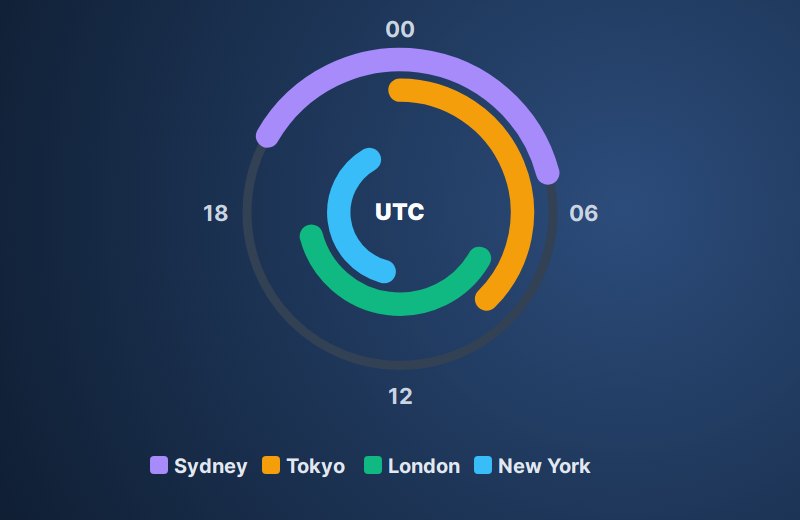
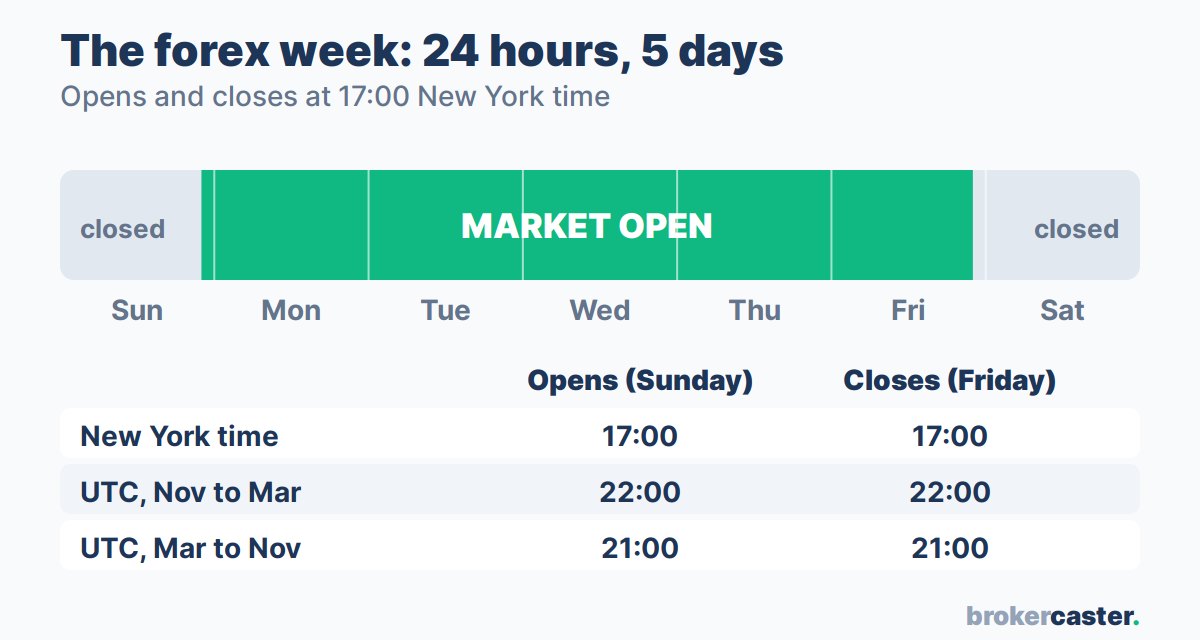
The forex market is open 24 hours a day, five days a week: it opens on Sunday at 17:00 New York time and closes on Friday at 17:00 New York time. In UTC that is 22:00 Sunday to 22:00 Friday from November to March, and an hour earlier (21:00) in the northern summer. There is no central exchange: trading moves around the world through four main sessions, Sydney, Tokyo, London and New York. The busiest hours are when two sessions overlap, above all London and New York.
Why forex is open 24 hours, five days a week
Shares trade on an exchange with fixed opening hours. Currencies do not: banks, brokers, funds and companies trade with each other electronically, and the forex market simply follows the working day of the big financial centres around the globe. When Sydney and Tokyo finish, London is starting; when London closes, New York is still open; and when New York closes, Sydney is about to open again.
The week starts in Wellington and Sydney on Monday morning local time, which is still Sunday evening in Europe and America, and it ends when New York closes on Friday. At the weekend the interbank market is closed, so normal currency pairs cannot be traded and prices do not move (more on weekends below).
A trading session is simply the business hours of one centre. The hours are a convention, not an official timetable: different sources shift them by an hour, but the picture is the same everywhere.
Forex trading session times in UTC
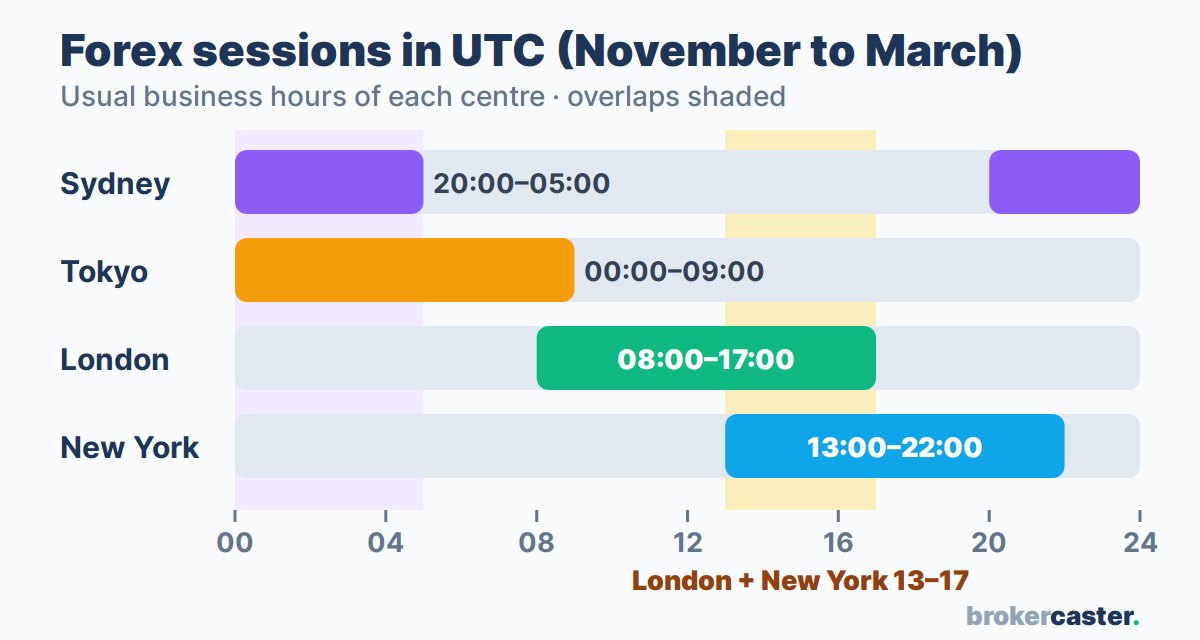
These are the usual session hours, shown in UTC for the period from early November to mid-March (the northern winter). Convert them to your own time zone once and you will know your trading day.
| Session | Local hours | UTC, Nov to Mar | UTC, Apr to Oct | Most active pairs |
|---|---|---|---|---|
| Sydney | 07:00–16:00 | 20:00–05:00 | 21:00–06:00 | AUD/USD, NZD/USD |
| Tokyo | 09:00–18:00 | 00:00–09:00 | 00:00–09:00 | USD/JPY, AUD/JPY, EUR/JPY |
| London | 08:00–17:00 | 08:00–17:00 | 07:00–16:00 | EUR/USD, GBP/USD, EUR/GBP |
| New York | 08:00–17:00 | 13:00–22:00 | 12:00–21:00 | EUR/USD, USD/CAD, USD/JPY, gold |
Japan does not use daylight saving time, so the Tokyo session stays at 00:00–09:00 UTC all year. The others move by one hour when their clocks change, and they do not change on the same day (see the mistakes section).
London is the largest forex centre according to the Bank for International Settlements' triennial survey, followed by New York, which is why the European morning and the London and New York overlap carry the most volume.
Session overlaps and the best time to trade forex
Liquidity is highest when two big centres are open at the same time. More buyers and sellers usually mean tighter bid and ask spreads and larger moves.
- London and New York (13:00–17:00 UTC in winter, 12:00–16:00 UTC in summer): the busiest four hours of the day. Most major US data comes out at 08:30 New York time (13:30 UTC in winter), inside this window.
- Tokyo and London (about one hour around 08:00 UTC): short, but it often starts the European move in yen and euro pairs.
- Sydney and Tokyo (00:00–05:00 UTC in winter): calmer, with most action in AUD, NZD and JPY pairs.
So the best time to trade forex depends on what you trade. EUR/USD and GBP/USD are most active from the London open to the London close. USD/JPY moves in Tokyo and again in New York. AUD/USD often moves on Australian data in the Asian morning. The quietest period is usually after New York closes and before Tokyo opens, when spreads are often at their widest.
Keep the economic calendar open: a central bank decision or a jobs report can move a pair more in one minute than a whole quiet session. Spreads widen in the seconds around such releases, so a stop loss can fill further away than planned (see stop loss and take profit).
Weekly open, daily close and rollover
Three moments of the trading week matter for every position you hold:
- The Sunday open (22:00 UTC in winter). Prices can open away from Friday's close if news broke at the weekend. This jump is called a gap, and pending orders and stops are filled at the first available price, not at your level.
- The daily close at 17:00 New York time. This is the end of the forex trading day. Positions still open at this time are rolled over to the next day and receive or pay swap (overnight interest). Liquidity is thin for a few minutes around rollover, so spreads can widen sharply. Most brokers charge three days of swap once a week, usually on Wednesday night, to cover the weekend; check your broker's contract specifications and estimate it with our swap calculator.
- The Friday close (22:00 UTC in winter). Anything you keep open over the weekend carries the risk of a Monday gap.
In MT4/MT5 the clock in Market Watch shows the broker's server time, not yours. Many MT4/MT5 brokers set their servers to UTC+2 in winter and UTC+3 in summer so that each daily candle starts at the New York close; this gives five daily candles a week. cTrader lets you choose the time zone shown on the chart (bottom-right corner), and TradingView lets you set the chart time zone in the settings, where you can also add a session indicator to shade each session. Always check which clock your platform uses before you plan a trade around a session.
Weekend trading and session rules at different brokers
Spot currency pairs do not trade at the weekend, but some brokers now quote a few products on Saturday and Sunday, and some cut leverage before the weekend because of gap risk. In our reviews (checked November 2026) these brokers publish such rules:
| Broker | Weekend or 24/7 product | Leverage rule around weekends or news |
|---|---|---|
| Vantage Markets | Gold 24/7 | 24/7 gold up to 1:500, tiered by position size |
| STARTRADER | Gold 24/7 | 24/7 gold up to 1:500 |
| VT Markets | Gold 24/7; 18 synthetic indices | Not stated |
| PU Prime | Gold 24/7 | Temporarily lower leverage around major news |
| Blueberry Markets | Weekend gold, silver and oil | Not stated |
| INGOT Brokers | Weekend gold | Not stated |
| FXPrimus | 18 synthetic indices, 24/7 (PrimusSYNTHETICS account) | Not stated |
| Dukascopy | None listed | 1:50 at weekends (Dukascopy Bank SA, normally up to 1:100) |
| Opofinance | None listed | Temporary 1:100 cap on FX before weekends and news |
Weekend gold is a broker's own product: the main gold market is closed, so the price and spread come from the broker, and positions may be handled differently when the normal market reopens. Synthetic indices are not linked to a real market, so they follow no session at all. Read the contract specifications before you trade either. A leverage cut before the weekend raises the margin your open trades need, which can bring a full account close to a margin call on Friday afternoon.
Common mistakes with forex market hours
- Forgetting daylight saving time. The US and Europe change their clocks on different dates. In 2026 the UK went back to winter time on 25 October and the US on 1 November, so for one week the New York session started an hour earlier for European traders. In spring 2027 the US moves to summer time on 14 March and the UK on 28 March: for two weeks the London and New York overlap is 12:00–17:00 UTC instead of four hours. Australia's summer time runs the other way (October to April).
- Reading the server clock as local time. A daily candle that "opens at midnight" on an MT5 chart usually opens at 22:00 UTC in winter.
- Trading at rollover. Market orders placed in the minutes after 17:00 New York time can pay a much wider spread.
- Ignoring holidays. Christmas, New Year and national holidays thin out one or more sessions, and many brokers publish shortened trading hours for those days.
- Holding a full-size position over the weekend without a plan for a gap. Size it with the pip value of the pair in mind (see what is a pip and lot size in forex).
Forex market hours FAQ
What time does the forex market open on Sunday?
At 17:00 New York time, which is 22:00 UTC from November to March and 21:00 UTC in the northern summer. Some brokers start quoting a few minutes later than the market opens.
Is the forex market open on weekends?
No. Currency pairs do not trade from the Friday close to the Sunday open. Some brokers offer weekend gold, other weekend CFDs or synthetic indices, but those are separate products with their own prices and rules.
Which forex session is the most active?
London, and especially the four hours when London and New York are both open (13:00–17:00 UTC in winter). That is when major pairs usually have the most volume and the tightest spreads.
What is the worst time to trade forex?
For most pairs, the hour around the 17:00 New York rollover, the Friday close and the Sunday open, when liquidity is thin and spreads widen. Major holidays are quiet as well.
Why does my MT4/MT5 chart show a different time?
MetaTrader shows the broker's server time, which is often UTC+2 or UTC+3. Compare the server clock in Market Watch with your own clock to find the difference.