

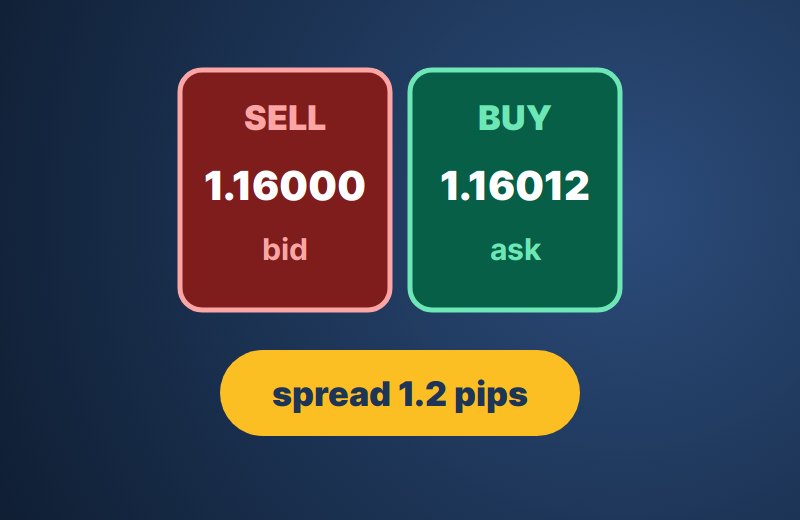
Every forex price has two sides. The bid price is what the market will pay you, so it is the price you sell at. The ask price (also called the offer) is what you pay, so it is the price you buy at. The ask is always a little higher than the bid, and the difference between them is the spread. The spread is the first cost of every trade: the moment you open a position you are down by the spread, before the price has moved at all. This lesson shows how to read a two-way quote, how to turn the spread into money, why it widens, and how spreads compare between brokers.
What the bid and ask price are
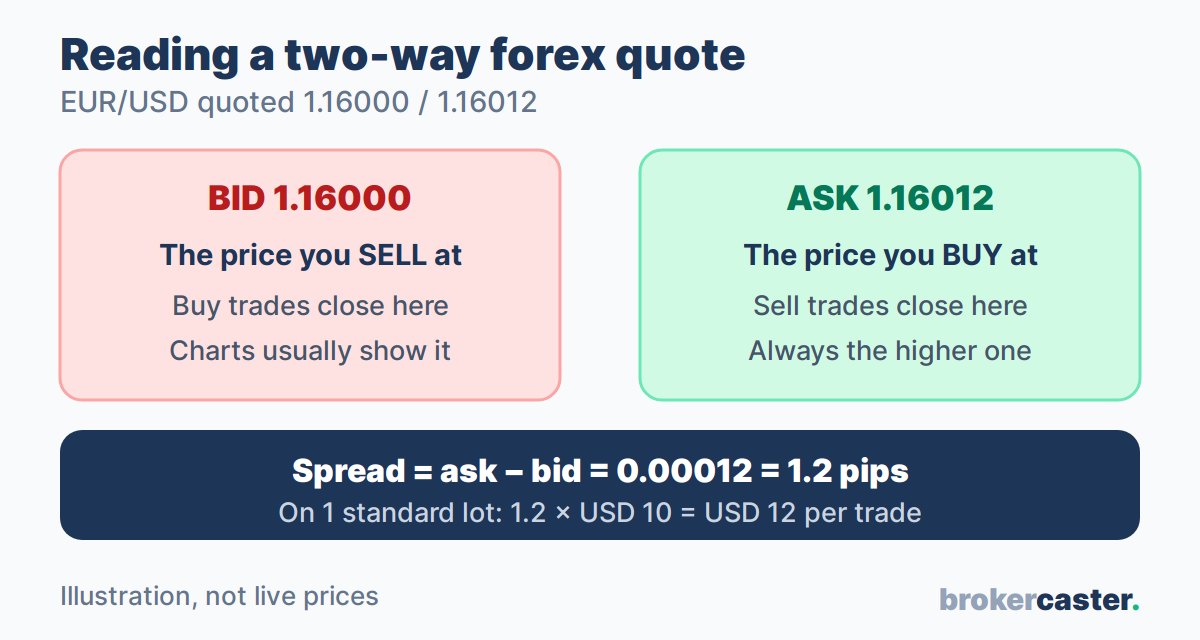
A forex quote such as EUR/USD 1.16000 / 1.16012 shows two prices. The left one is the bid, the right one is the ask. Think of a currency exchange booth at an airport: it buys your euros at one rate and sells you euros at a higher rate, and keeps the gap. A forex broker works the same way, only with much smaller gaps.
| Bid | Ask (offer) | |
|---|---|---|
| Who gets this price | You, when you sell | You, when you buy |
| Which is higher | Always the lower price | Always the higher price |
| Opens | A sell (short) trade | A buy (long) trade |
| Closes | A buy trade | A sell trade |
| Shown on most charts | Yes | Usually not, unless you turn on the ask line |
So a buy trade opens at the ask and closes at the bid, and a sell trade opens at the bid and closes at the ask. Either way you start one spread behind. The same rule decides where your stop loss and take profit trigger: on the bid for buys and on the ask for sells.
What the spread is and how to calculate it
The bid-ask spread is simply the ask minus the bid. In forex it is measured in pips: 0.0001 on most pairs and 0.01 on yen pairs. Most brokers quote one extra digit (a pipette or «point»), so a 5-digit EUR/USD price moves in tenths of a pip.
Spread in pips = (ask − bid) ÷ pip size
Spread cost in money = spread in pips × pip value per lot × lots
The spread is paid once per round trip, not once when you open and again when you close: you buy at the ask and sell at the bid, and the gap between them is the whole cost. Our lot size lesson explains standard, mini and micro lots, and the pip value calculator gives the pip value for pairs where it is not USD 10 per lot, such as USD/JPY or gold.
| Quote | Pip size | Spread | Cost on 1 lot |
|---|---|---|---|
| EUR/USD 1.16000 / 1.16012 | 0.0001 | 1.2 pips | USD 12 |
| GBP/USD 1.31500 / 1.31516 | 0.0001 | 1.6 pips | USD 16 |
| USD/JPY 155.000 / 155.014 | 0.01 | 1.4 pips | about USD 9 (1.4 × 1,000 JPY ÷ 155) |
Why the spread changes during the day
Most brokers offer variable (floating) spreads: they follow the prices their liquidity providers stream, so they are tight when many banks and traders are active and wider when few are. A few brokers offer fixed spreads, which stay the same in normal conditions but are usually wider on average. Spreads tend to widen:
- At the daily rollover, around 5 pm New York time, when many liquidity providers reset and the market is thin for a few minutes.
- Around big news such as central bank decisions and jobs reports. Check the economic calendar before trading through a release.
- At the weekly open on Sunday night and before the Friday close.
- On minor and exotic pairs, which trade far less than EUR/USD, USD/JPY or GBP/USD, so their normal spread is many times wider.
This is why brokers advertise spreads «from» a number: it is the lowest spread, seen in the busiest hours on the most traded pairs, not what you pay all the time. A wider spread also means a stop loss can be hit by the ask even when the bid chart did not reach it.
Seeing bid, ask and spread in MT4/MT5, cTrader and TradingView
| Platform | Where to find it |
|---|---|
| MT4 / MT5 | The Market Watch window lists Bid and Ask for each symbol. Right-click it and add the «Spread» column; it is shown in points, so 12 points on a 5-digit pair is 1.2 pips. To see the ask on the chart, turn on the ask line in the chart properties. |
| cTrader | The order panel and the symbol list show the sell (bid) and buy (ask) prices with the spread in pips between them. |
| TradingView (broker connection) | The Sell and Buy buttons show the bid and the ask with the spread between them; bid and ask lines can be switched on in the chart settings. |
Charts on all three platforms are normally drawn from the bid. Keep that in mind when you read where a sell trade would have been closed.
Spreads and commissions at different brokers
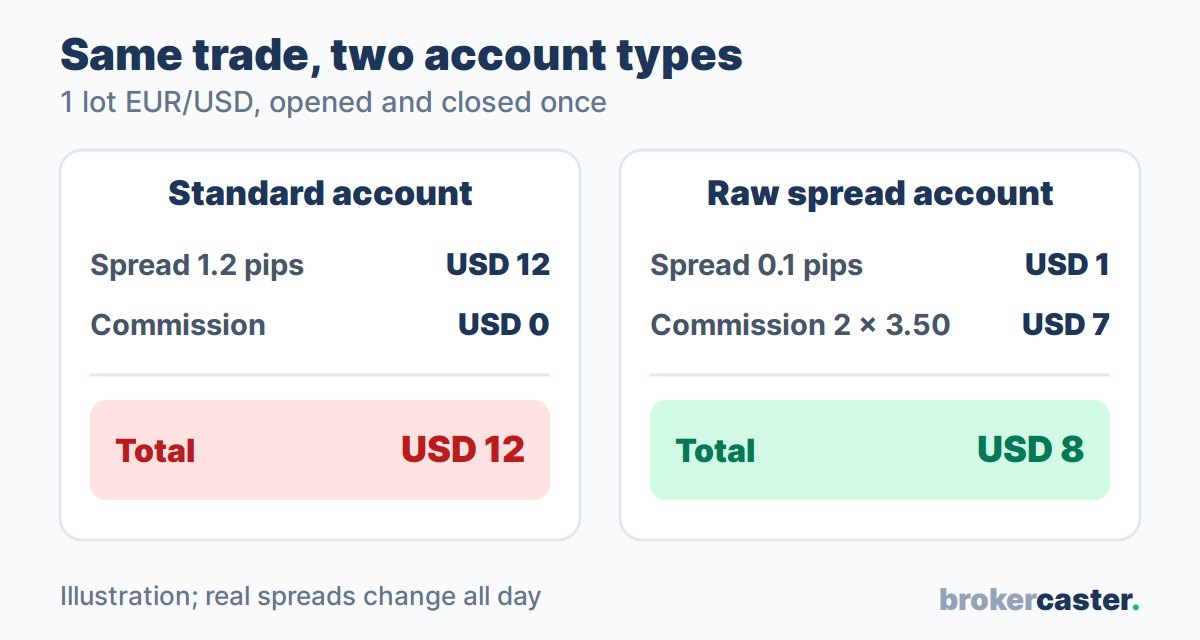
Brokers earn on trading in two ways: a mark-up added to the raw market spread, or a commission on top of a raw spread. A standard account usually has a wider spread and no commission; a raw spread (ECN) account has a spread near zero plus a commission per lot. Here is what our reviews show (checked November 2026; «from» figures are minimums, not averages):
| Broker | Spread-only account | Raw spread account |
|---|---|---|
| IC Markets | Standard: from 0.8 pips, no commission | Raw Spread: from 0.0 (EUR/USD average 0.1) + USD 3.50 per lot per side |
| Pepperstone | Standard: about 1 pip mark-up, no commission | Razor: from 0.0 + USD 3.50 per lot per side |
| Exness | Standard: from 0.2 pips, no commission | Raw Spread: from 0.0 + up to USD 3.50 per lot per side |
| Tickmill | Classic: from 1.6 pips, no commission | Raw: from 0.0 + USD 3 per lot per side |
| Alpari | Standard: from 1.2 pips, no commission | Pro ECN: from 0.0 + USD 2.50 per lot per side |
| FXTM | Micro: from 1.7 pips, no commission | Advantage: from 0.0 + USD 3.50 per lot per side |
| HFM | Premium: from 1.4 pips, no commission | Zero: from 0.0 + commission from USD 3 per lot |
| XM | Standard: EUR/USD from 1.6 pips; Ultra Low from 0.8, no commission | Not for international clients |
| IG | EUR/USD from 0.6 points, no commission on FX | No raw spread account |
| OANDA | Standard: EUR/USD from 1.0 pip, no commission | Only for very large volumes |
Our trading cost calculator adds spread and commission for any trade size, and you can compare every broker's accounts on the forex brokers list. Overnight positions also pay or earn a swap, which is a separate cost from the spread.
Common mistakes with bid, ask and spread
- Reading only the chart price. The chart shows the bid; you buy at the ask. A buy limit placed at a level the bid touched may never fill.
- Comparing «from» spreads. A 0.0-pip headline with a commission can cost more or less than a 1-pip spread with none. Compare the all-in cost per lot.
- Ignoring the spread on small targets. With a 1.2-pip spread, a 5-pip target gives away a quarter of the gain before the trade starts.
- Trading right at rollover or a major release without checking the spread first, then wondering why a stop was hit.
- Placing stops too close. A stop a few pips away on a sell trade can be reached by the ask alone when the spread widens.
FAQ
What is the bid and ask price in simple words?
The bid is the price at which you can sell right now and the ask is the price at which you can buy right now. The ask is always the higher of the two.
Do I buy at the bid or the ask?
You buy at the ask and sell at the bid. A buy trade is later closed at the bid, and a sell trade is closed at the ask.
What is a spread in forex?
It is the difference between the ask and the bid, measured in pips. EUR/USD at 1.16000 / 1.16012 has a spread of 1.2 pips, which costs about USD 12 on one standard lot.
Is a zero spread really free?
No. Accounts with spreads from 0.0 pips usually charge a commission per lot, for example USD 3.50 per side, and the spread is 0.0 only part of the time. Add both to see the real cost.
Why does the spread widen at night?
Around the daily rollover, about 5 pm New York time, few liquidity providers are quoting, so the gap between the best bid and the best ask grows for a while. It narrows again once trading picks up.