

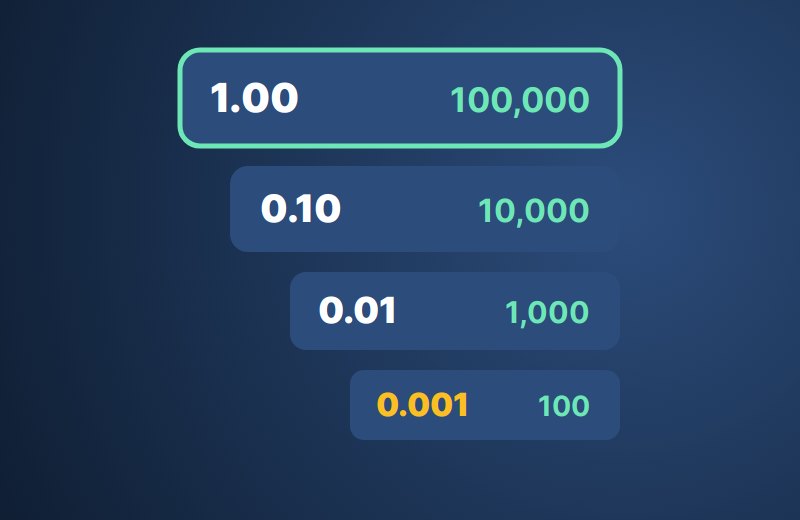
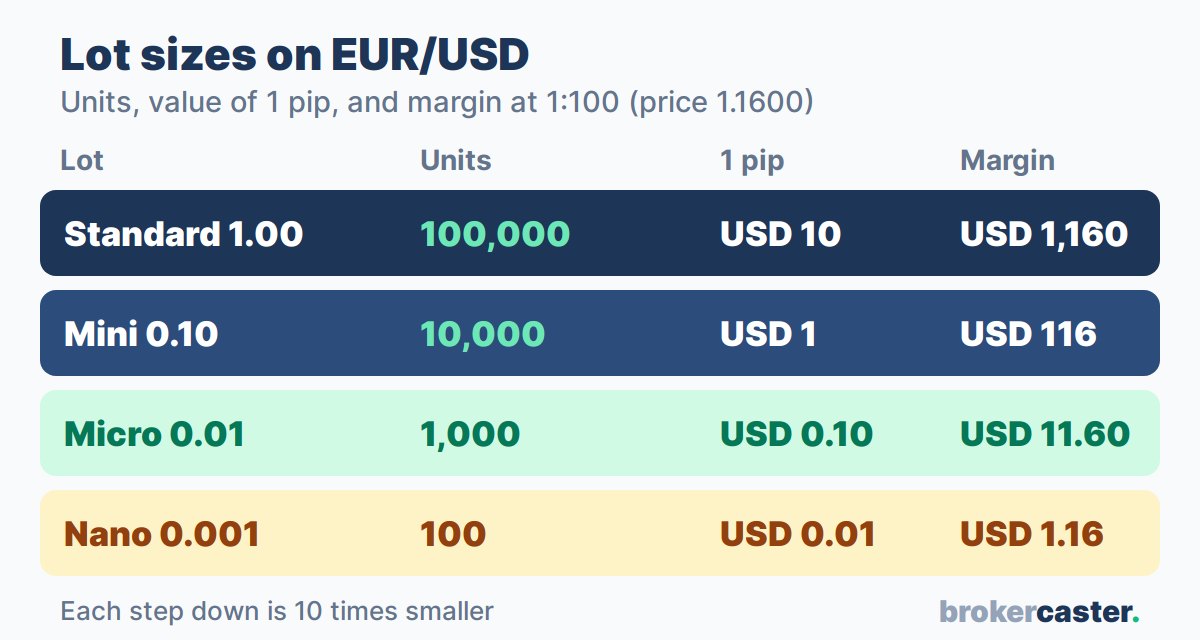
In forex, a lot is the unit you use to say how big a trade is. One standard lot is 100,000 units of the base currency, a mini lot (0.10) is 10,000 units, a micro lot (0.01) is 1,000 units and a nano lot (0.001) is 100 units. Your lot size decides how much each pip is worth: on EUR/USD that is USD 10 per pip on 1 lot and USD 0.10 on 0.01 lot. This lesson explains the lot types, the formulas behind them, how to pick a lot size from the money you are ready to risk, and the minimum and maximum trade sizes brokers allow.
Standard, mini, micro and nano lots
Brokers count trade size in lots so that every platform and every pair use the same scale. A lot is always a number of units of the base currency, the first currency of the pair: 1 lot of EUR/USD is EUR 100,000, and 1 lot of GBP/JPY is GBP 100,000.
| Name | Lots | Units | 1 pip on EUR/USD |
|---|---|---|---|
| Standard lot | 1.00 | 100,000 | USD 10 |
| Mini lot | 0.10 | 10,000 | USD 1 |
| Micro lot | 0.01 | 1,000 | USD 0.10 |
| Nano lot | 0.001 | 100 | USD 0.01 |
On MT4 and MT5 you type the size as a decimal, so «mini» and «micro» are just names for 0.10 and 0.01. You can also trade any size in between, such as 0.37 lot (37,000 units). Nano lots do not exist as a 0.001 setting on most platforms; you get the same small size through a cent account, explained below.
How lot size changes pip value and margin
Two numbers grow in direct proportion to your lot size: the money you make or lose per pip, and the margin the broker locks to keep the trade open.
- Units = lots × 100,000
- Pip value (in the quote currency) = units × pip size (0.0001, or 0.01 on yen pairs)
- Margin = units × price ÷ leverage, converted into your account currency
Leverage changes only the margin, not the pip value. A trade of 0.30 lot gains or loses USD 3 per pip whether your leverage is 1:30 or 1:500; higher leverage just lets a smaller deposit open it. That is why a big lot on a small account can reach a margin call after a short move. Check any pair, including yen pairs and crosses where the pip value changes with the rate, with our pip value calculator and margin calculator.
Choosing a lot size from your risk
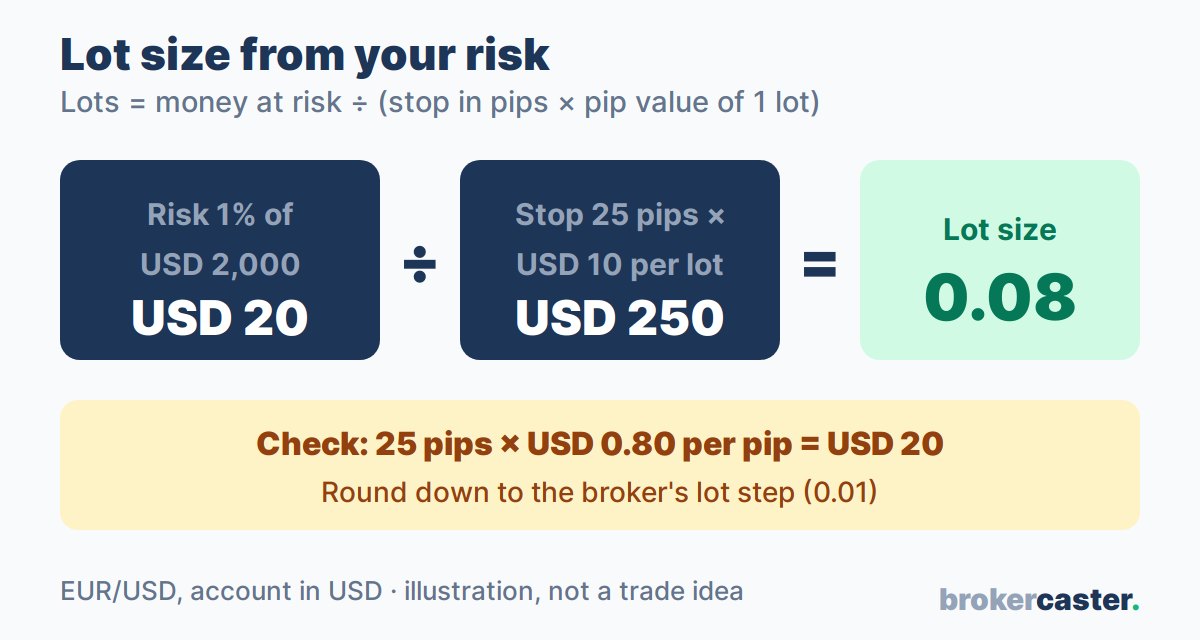
The safest way to choose a lot size is to start from the loss you accept on one trade, not from the largest position your margin allows. Many traders use 1% or 2% of the account. The formula is:
Lots = money at risk ÷ (stop-loss in pips × pip value of 1 lot)
Always round down to the broker's lot step (usually 0.01). If the result is below the minimum size, the trade is too large for your risk plan: use a tighter stop only if the chart allows it, a cent account, or skip the trade. Our lot size calculator does this sum for any pair, gold and indices, using live prices. This example illustrates the arithmetic only; it is not a trade idea.
Lot size in MT4/MT5, cTrader and TradingView
Each platform shows trade size a little differently, and mixing up the units is a common way to open a position ten or a hundred times too big.
| Platform | How size is entered | What to check |
|---|---|---|
| MT4 / MT5 | «Volume» in lots (0.01 = 1,000 units on forex) | The symbol's «Specification» window shows the contract size, minimum volume, volume step and maximum volume. |
| cTrader | Quantity in units or in lots, depending on your settings | 1,000 units = 0.01 lot; the symbol info shows the lot size and minimum quantity. |
| TradingView (broker connection) | Often units for forex, but it depends on the broker | Type 1,000 units for a micro lot; look at the pip value the order panel shows before you send. |
Gold, indices and oil use other contract sizes. On many MT4/MT5 accounts 1 lot of XAU/USD is 100 ounces, so a USD 1 move in gold is worth USD 100 per lot, while 1 lot of an index CFD can be 1, 10 or 100 contracts depending on the broker. Never assume a forex lot: read the contract specification of the symbol first.
Minimum and maximum lot sizes at different brokers
Most brokers accept trades from 0.01 lot, but some accounts start higher, and every broker caps the size of one order. A cent account is the practical way to trade smaller than a micro lot: the balance is shown in cents (a USD 10 deposit shows as 1,000 USC), so a 0.01-lot trade usually moves your real money by about a hundredth of what it would on a standard account; check the contract size, as brokers set cent accounts up differently. Some brokers instead run «micro» accounts where 1 lot is only 1,000 units. These are the published figures in our reviews (checked November 2026):
| Broker and account | Trade size rule |
|---|---|
| Swissquote Standard / Premium / Prime | Minimum 0.01 lot / 0.1 lot / 1 lot |
| Tradeview Markets EDGE and Classic ILC | Minimum 0.10 lot (0.01 on EDGE Premium and XLev) |
| Eightcap Standard and Raw | 0.01 to 100 lots |
| Global Prime Standard and Raw | 0.01 to 1,000 lots |
| Trive Standard / VIP | 0.01 to 50 / 0.01 to 100 lots per position |
| Dupoin Cent, Standard, Premium | 0.01 to 20 lots |
| Plexytrade Micro / Silver | Maximum 5 / 50 lots per order |
| HFM Cent | 1 lot = 1,000 units |
| XS.com Micro | 1 lot = 1,000 units, minimum 0.1 lot |
| Headway Cent | Balance in US cents, 0.01 to 1,000 lots |
| Exness Standard Cent | Balance in cents (USC, EUC, GBC and others) |
Because «lot» can mean 100,000 or 1,000 units depending on the account, always read the contract size before you compare spreads or commissions per lot. A demo account is a free way to see these settings: compare them in our forex demo accounts comparison.
Common mistakes with lot size
- Choosing the lot from leverage. High leverage lets you open 1 lot on a USD 500 account, but then a 50-pip move costs USD 500. Start from risk, as shown above.
- Thinking 0.01 lot is always «a cent per pip». It is USD 0.10 per pip on EUR/USD, and different on yen pairs, crosses and gold.
- Using a forex lot on gold or indices. Their contract sizes differ, so the same 0.10 lot can carry ten times more risk.
- Ignoring the account type. On a cent or micro account a lot is smaller; on accounts with a 0.10 minimum you cannot open 0.01.
- Adding lots to a losing trade. Doubling the size to win back a loss doubles the pip value exactly when the position is going against you.
- Forgetting costs scale too. Spread and commission are charged per lot, so a bigger lot pays proportionally more; see pips and pip value for how costs are counted.
New to the market? Start with what forex trading is and how the market works. Trading with leverage can lose money quickly; size every position so that one loss is small.
FAQ
What is a lot in forex in simple words?
It is the standard trade size unit. One standard lot is 100,000 units of the base currency, and most traders use fractions of it such as 0.10 or 0.01 lot.
How much is 0.01 lot in dollars?
On EUR/USD, 0.01 lot is 1,000 euros of currency, worth about USD 1,160 at a 1.1600 rate. It moves about USD 0.10 per pip, so a 20-pip move is about USD 2. The margin needed depends on your leverage: about USD 11.60 at 1:100.
How much is 0.1 lot worth per pip?
On pairs quoted in US dollars (EUR/USD, GBP/USD, AUD/USD) it is USD 1 per pip. On other pairs it depends on the exchange rate; our pip value calculator gives the exact figure.
What lot size should a beginner use?
The one that keeps the loss on each trade small, often 1% of the account or less. On a small account that usually means 0.01 lot or a cent account, and practising first on a demo.
What is the biggest lot size in forex?
There is no market-wide limit, but each broker caps one order: in our reviews from 5 lots on a micro account up to 1,000 lots on some standard accounts. Large orders can also fill at a worse price when liquidity is thin.