

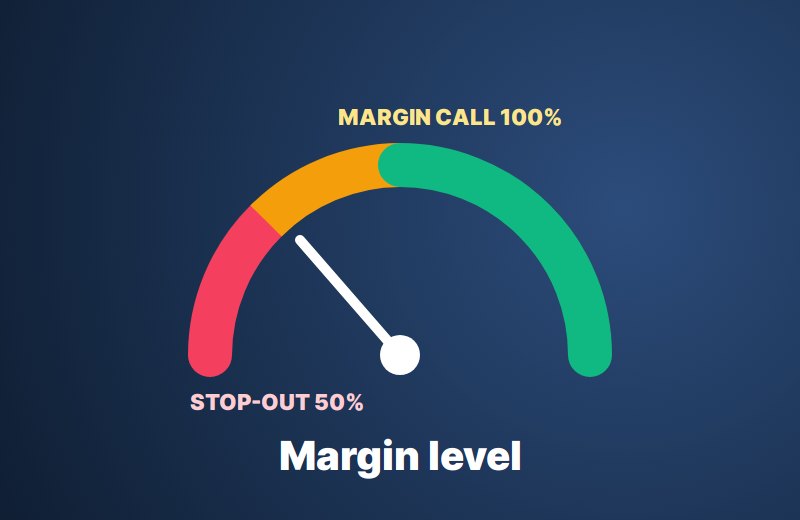
A margin call happens when the money left in your trading account (your equity) falls too close to the margin your open positions are using. Most brokers measure this with the margin level: when it drops to the broker's margin call level you get a warning, and when it drops further to the stop-out level the broker starts closing your positions automatically.
Margin, equity and margin level
- Margin (used margin) is the deposit the broker locks to keep a leveraged position open: position value ÷ leverage.
- Equity is your balance plus or minus the profit or loss of open positions.
- Free margin is equity minus used margin: the money available for new trades or to absorb losses.
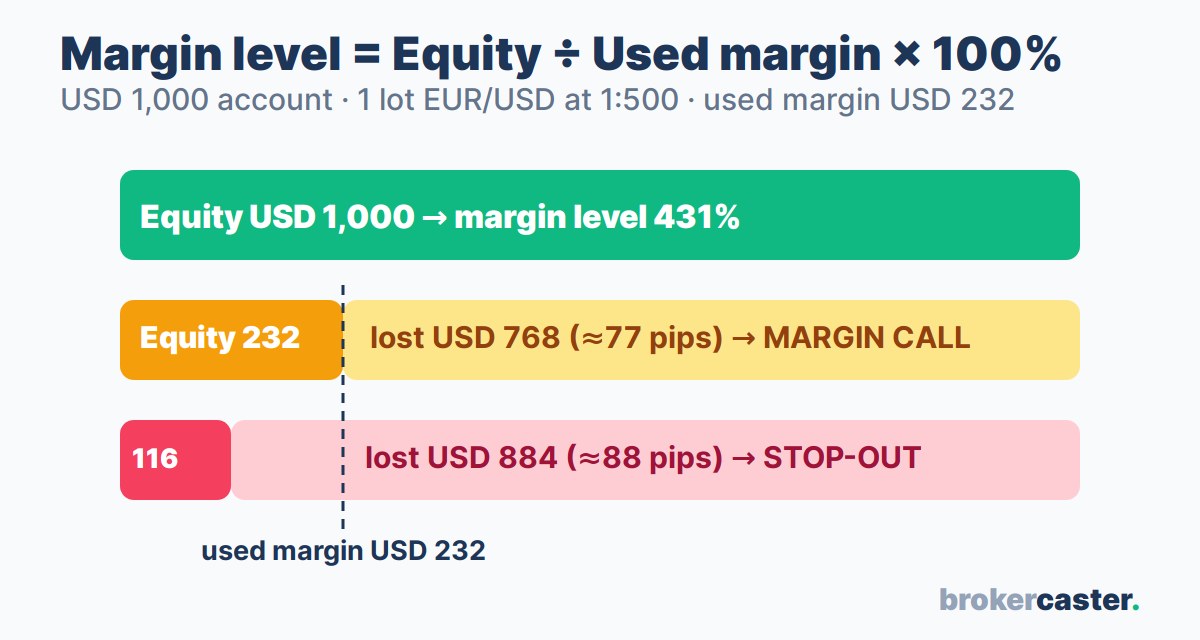
- Margin level = equity ÷ used margin × 100%.
At a 100% margin level your equity equals your used margin and you have no free margin left. Most brokers send the margin call at 100% or a little below, and stop you out at 50% or lower.
Worked example: when does the margin call come?
You deposit USD 1,000, your leverage is 1:500, and you buy 1 standard lot of EUR/USD at 1.1600 (a position worth USD 116,000).
| Step | Calculation | Result |
|---|---|---|
| Used margin | 116,000 ÷ 500 | USD 232 |
| Margin level at the start | 1,000 ÷ 232 × 100 | 431% |
| Margin call at 100% | equity falls to USD 232: a loss of USD 768 | after about 77 pips |
| Stop-out at 50% | equity falls to USD 116: a loss of USD 884 | after about 88 pips |
One pip on a standard EUR/USD lot is worth USD 10, so a 77-pip move against you triggers the margin call and an 88-pip move closes the trade. Higher leverage does not change this: the loss per pip depends on the position size, not on the leverage setting. Leverage only decides how large a position your deposit lets you open. Check your own numbers with our margin call and stop-out calculator and margin calculator.
Margin call and stop-out levels at different brokers
Every broker sets its own levels, sometimes per account type. These are the levels published by the brokers in our database (international companies, from our reviews):
| Broker | Margin call | Stop-out |
|---|---|---|
| Exness | 60% (Standard, Cent); 30% (Pro, Raw, Zero) | 0% |
| IC Markets | 100% | 50% |
| Pepperstone | – | 50% of required margin (MT4/MT5) |
| OANDA | – | 50% |
| Fusion Markets | 90% | 20% |
| Dukascopy (MT4/MT5) | 100% | 50% |
| LiteFinance | 100% | 20% |
| Valetax | 60% | 30% |
| Weltrade | 100% | 10% (50% on SyntX) |
| GO Markets | 80% | 50% |
| BlackBull Markets | 70% | 50% |
| CMTrading | 100% | 50% |
| IC Trading | 100% | 50% |
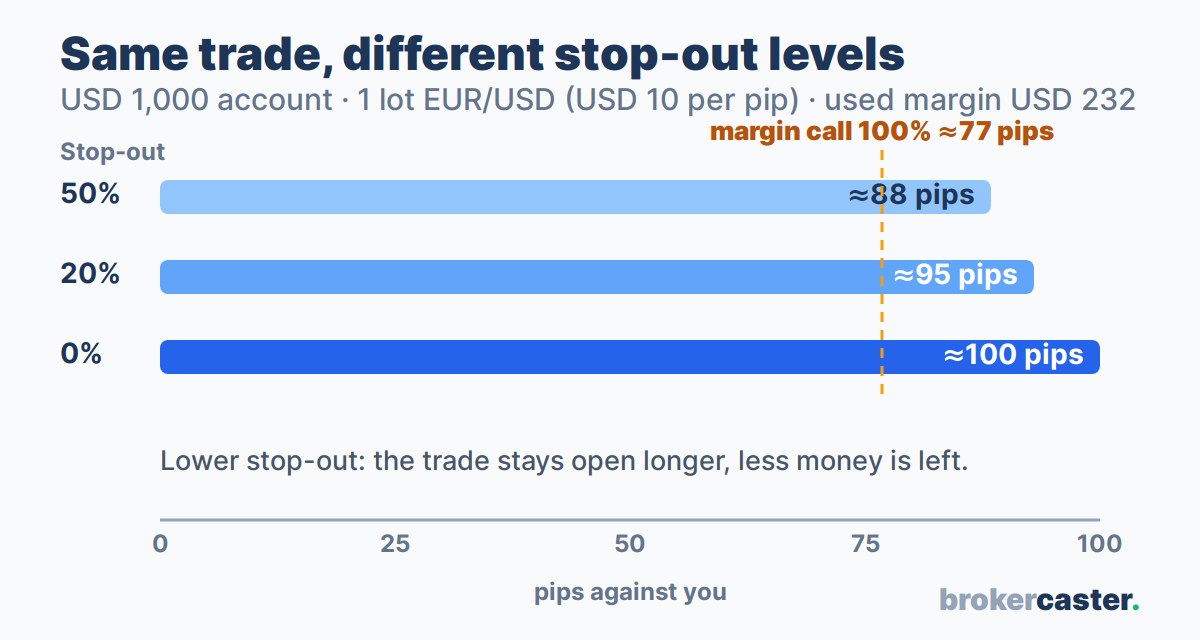
A lower stop-out level (such as 0% or 10%) lets a losing trade run longer, but it also means less of your money is left when the position is finally closed.
What happens at the stop-out
When your margin level reaches the stop-out level, the broker closes positions automatically, usually starting with the biggest loser, until the margin level is back above the stop-out level. In a fast market the closing price can be worse than the stop-out price, and your balance can go below zero.
With negative balance protection the broker resets a negative balance to zero, so you cannot lose more than you deposited. Not every broker offers it to international clients: compare the column in our high-leverage brokers comparison.
How to avoid a margin call
- Size positions by risk, not by leverage. Decide how much of your account you accept to lose on a trade (often 1–2%) and work out the lot size with our position size calculator.
- Use a stop-loss that closes the trade well before the margin call level.
- Keep free margin: avoid opening several large positions on correlated pairs at once.
- Watch weekends and news: many brokers raise margin requirements before weekends and major news, and prices can gap.
- Do not add to a losing position just to «average down»: it uses more margin exactly when you have least.
FAQ
What is a margin call in simple words?
It is the broker's warning that your account has almost no free money left to support your open trades. If losses continue, the broker will close positions for you.
What margin level triggers a margin call?
It depends on the broker: commonly 100%, but some brokers use 60%, 70%, 80% or 90%. The table above lists the levels of 13 brokers.
What is the difference between a margin call and a stop-out?
The margin call is a warning; the stop-out is the level at which the broker actually closes your positions. The stop-out is always lower than the margin call level.
Does higher leverage cause a margin call?
Not by itself. Margin calls come from position size and losses. Higher leverage makes it easier to open a position that is too large for your account, which is why it increases the risk.
Can I owe money after a stop-out?
Only if your broker does not offer negative balance protection and the market gaps past the stop-out level. Check the broker's client agreement.