

Forex trading (foreign exchange, or FX) is buying one currency and selling another at the same time, hoping to profit when the exchange rate between them changes. Currencies are always traded in pairs such as EUR/USD: if you buy EUR/USD and the euro rises against the dollar, you make a profit; if it falls, you lose. Most private traders do this through an online broker, usually with leverage, which means a small deposit controls a much larger position and losses grow just as fast as profits. This lesson is the starting point of our free course: it explains how the market works, walks through one trade in numbers and shows what you need to begin.
How the forex market works
The forex market is where the world's currencies are exchanged. It is the largest financial market: according to the Bank for International Settlements (BIS) Triennial Survey published on 30 September 2025, global FX trading reached USD 9.6 trillion per day in April 2025.
There is no central exchange. Forex is an over-the-counter (OTC) market: banks, brokers and other institutions trade with each other electronically around the world. That is why it runs 24 hours a day, five days a week, moving from the Asian session to London and then New York, and closes over the weekend.
- Banks and dealers make prices and trade for themselves and their clients.
- Companies exchange currencies to pay for imports or bring home foreign earnings.
- Central banks manage reserves and set interest rates, which move currencies (see our central bank interest rates page).
- Funds and retail traders speculate on price changes. Retail traders reach the market through a broker, mostly with contracts for difference (CFDs) or rolling spot contracts, so they never take delivery of the actual currency.
Exchange rates move with interest rate expectations, inflation, growth data, central bank decisions and risk sentiment. Scheduled releases such as US jobs data or a rate decision can move prices sharply within seconds, which is why many traders watch the economic calendar.
Currency pairs and how to read a quote
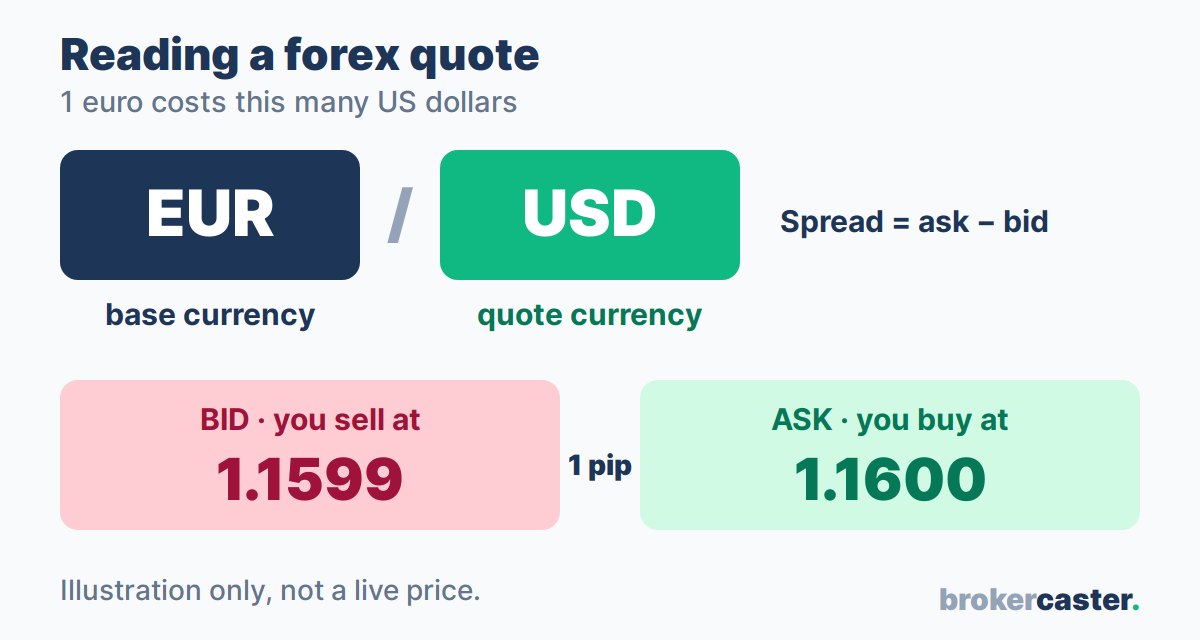
A forex quote shows how much of the second currency (the quote currency) you need to buy one unit of the first (the base currency). EUR/USD at 1.1600 means one euro costs 1.16 US dollars.
Your broker always shows two prices: the bid (the price at which you sell) and the ask (the price at which you buy). The gap between them is the spread, the main built-in cost of a trade. Price changes are counted in pips: for most pairs a pip is the fourth decimal (0.0001); for pairs quoted in Japanese yen it is the second decimal (0.01).
| Group | Examples | What it means |
|---|---|---|
| Majors | EUR/USD, USD/JPY, GBP/USD, USD/CHF, AUD/USD, USD/CAD | The US dollar against another big currency; usually the tightest spreads |
| Minors (crosses) | EUR/GBP, EUR/JPY, GBP/JPY | Two big currencies without the US dollar |
| Exotics | USD/TRY, USD/ZAR, USD/MXN | A major currency against an emerging-market one; wider spreads and bigger jumps |
How a forex trade works: a worked example
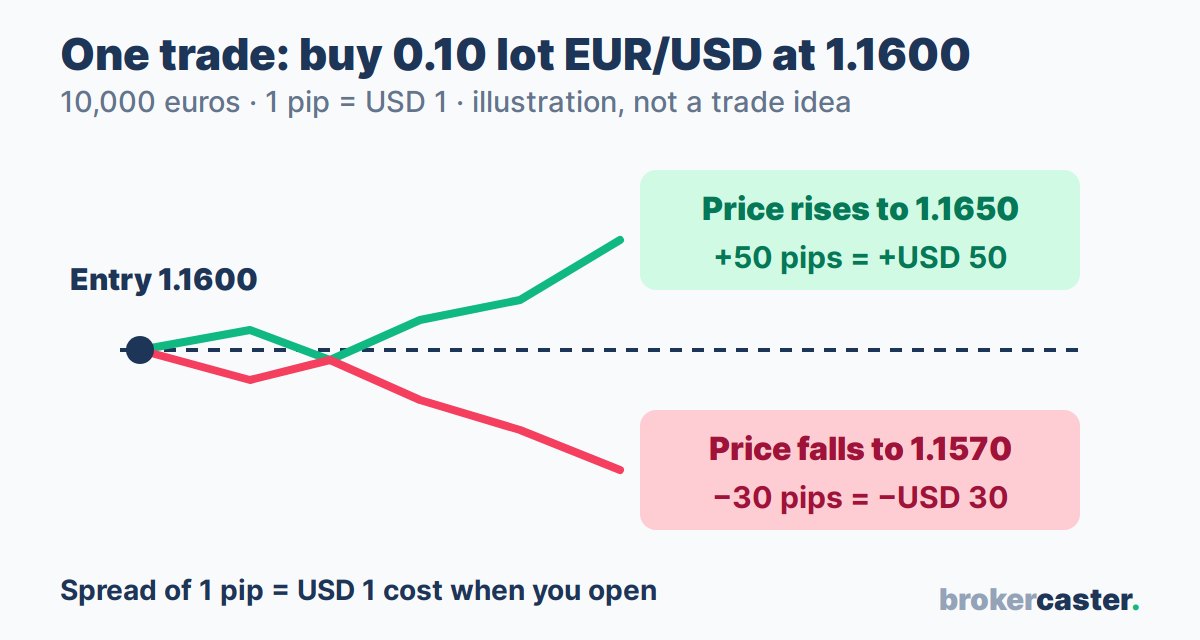
You can buy (go long) if you expect the base currency to rise, or sell (go short) if you expect it to fall. Position size is measured in lots: 1 standard lot is 100,000 units of the base currency, 0.10 lot is 10,000 units and 0.01 lot is 1,000 units.
- If you later close at 1.1650 (the bid), the price moved 50 pips in your favour: profit USD 50.
- If you close at 1.1570, it moved 30 pips against you: loss USD 30.
- With a 1-pip spread you start USD 1 behind, because you buy at the ask and close at the lower bid. Some accounts also charge a commission per lot.
The formulas behind the example (for pairs quoted in US dollars):
| What | Formula | In the example |
|---|---|---|
| Profit or loss (buy) | (close price − open price) × units | (1.1650 − 1.1600) × 10,000 = USD 50 |
| Pip value | units × pip size | 10,000 × 0.0001 = USD 1 |
| Position value | units × price | 10,000 × 1.1600 = USD 11,600 |
| Margin needed | position value ÷ leverage | 11,600 ÷ 30 = USD 386.67 at 1:30 |
For a sale the profit formula is reversed: (open − close) × units. For pairs not quoted in US dollars the result comes out in the quote currency and is converted to your account currency. Our pip value calculator and profit calculator do the conversion for any pair.
Leverage and margin: why forex is risky
Leverage lets you open a position larger than your deposit. The broker locks part of your money as margin (position value ÷ leverage) and lends you the rest of the exposure. In the example, the USD 11,600 position needs USD 386.67 of margin at 1:30, but only USD 23.20 at 1:500.
Leverage does not change the value of a pip: the 30-pip loss is still USD 30. What it changes is how big a position your deposit allows. If you use high leverage to open 1 standard lot on a USD 500 account, every pip is worth USD 10, and a 50-pip move costs you the whole account. When losses eat into your margin you get a margin call and then a stop-out, explained step by step in our lesson What is a margin call?.
Limits depend on where your account is held. In our reviews (checked November 2026), IG, Tickmill and XM cap retail clients of their UK or EU companies at 1:30 on major pairs, while their international companies offer 1:200, 1:1000 and 1:1000 respectively. The full list is in our high-leverage forex brokers comparison. Work out the margin of any position with the margin calculator.
What you need to start: broker, account and platform
- A broker, the company that holds your money and executes your trades. Check which company and which regulator your account would actually be with: the brand's best-known licence often covers other countries only. Our guide to regulated forex brokers explains how to check.
- An account: most brokers ask for identity and address documents (KYC) before you can deposit or withdraw. Start with a demo account funded with virtual money.
- A platform: MetaTrader 4 or MetaTrader 5 (MT4/MT5), cTrader, TradingView or the broker's own app. In all of them you choose the pair, the volume in lots, and click buy or sell, with optional stop-loss and take-profit levels.
- A plan for risk: how much of your account you accept to lose per trade. The lot size calculator turns that amount and your stop-loss distance into a position size.
Here is what the highest-rated brokers in our database show for international clients (from our reviews, checked November 2026):
| Broker | Company for international clients | Min. deposit |
|---|---|---|
| IC Markets | Raw Trading Ltd, FSA Seychelles | None to open |
| Pepperstone | Pepperstone Markets Ltd, SCB Bahamas | None (USD 10 per card deposit) |
| Fusion Markets | FSA Seychelles or VFSC Vanuatu company | None |
| IG | IG International Ltd, Bermuda Monetary Authority | None by bank transfer; USD 50 by card |
| Tickmill | Tickmill Ltd, FSA Seychelles | USD 100 |
| XM | XM International MU Ltd, FSC Mauritius | USD 5 |
| Exness | Exness (SC) Ltd, FSA Seychelles | None on Standard |
| OANDA | OANDA Global Markets Ltd, BVI FSC | None on Standard |
Negative balance protection (you cannot lose more than your deposit): yes at Pepperstone and IG for retail clients, and at Tickmill, XM and Exness; discretionary at Fusion Markets; not offered by IC Markets and OANDA. None of these international companies holds a tier-1 licence for your account, which is common for brokers serving clients worldwide. Compare more brokers on our forex brokers list.
Common mistakes beginners make
- Trading real money too early. Use a demo account until you can follow your own rules for weeks, then start with the smallest size your broker allows (often 0.01 lot).
- Choosing leverage instead of position size. Decide the loss you accept first, then size the trade; high leverage only makes oversized trades possible.
- No stop-loss. A single news move can take more than a month of small profits.
- Ignoring costs. Spread, commission and the overnight swap add up, especially if you trade often.
- Believing in guaranteed returns. Anyone promising fixed monthly profits from forex, or asking you to send money to a personal account, is a warning sign.
Trading leveraged products such as forex and CFDs carries a high risk of losing money quickly. Only trade with money you can afford to lose.
FAQ
What is forex trading in simple words?
It is exchanging one currency for another to profit from changes in the exchange rate. You buy a pair such as EUR/USD if you think the first currency will rise against the second, and sell it if you think it will fall.
How does forex trading work for beginners?
You open an account with a broker, deposit money, and trade currency pairs on a platform like MT4, MT5, cTrader or TradingView. Your profit or loss equals the price move in pips times the pip value of your position size, minus costs.
How much money do I need to start forex trading?
Many brokers have no minimum or a very low one (USD 5 at XM, USD 100 at Tickmill in our reviews), and a 0.01-lot position on EUR/USD moves about USD 0.10 per pip. A small account lets you learn, but it is easy to overtrade it with leverage.
Is forex trading legal?
In most countries yes, through a licensed broker, but some countries restrict it to local banks or licensed firms. Our forex brokers by country pages explain the rules for several countries.
Can you get rich from forex trading?
Most retail traders lose money on leveraged forex and CFDs, and brokers in many regions must publish the share of losing accounts. Treat it as a high-risk activity, learn on a demo account first, and never trade money you need.