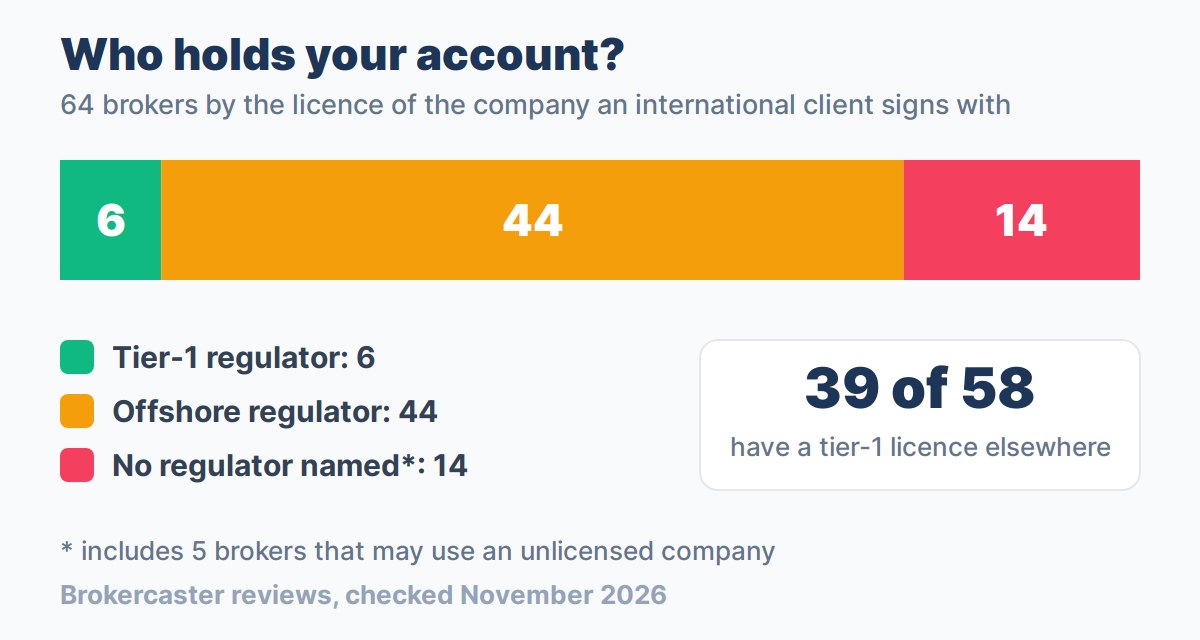
A regulated forex broker (or licensed forex broker) is a company that holds a licence from a financial regulator and must follow its rules on client money, capital and conduct. The catch: most broker brands are groups of several companies, and the licence that matters is the one held by the company that opens your account, not the best licence in the group. We checked this for all 64 brokers we review, using each broker's legal documents and the regulators' registers (in our reviews, checked November 2026).
How we compared regulated brokers
- The company that holds your account. For every broker we read the client agreement and the legal footer of the international website (the one a client outside the UK, the EU, Australia and the US is sent to) and noted which company signs the contract.
- That company's licence. We looked it up in the regulator's own register and recorded the licence number. «Tier-1» in this article means a strict national regulator: the FCA (UK), ASIC (Australia), CySEC and other EU regulators, FINMA (Switzerland), the US SEC/CFTC, MAS (Singapore) and similar. Seychelles, Mauritius, Vanuatu, the BVI, Belize, the Bahamas, Bermuda, the Cayman Islands and the Comoros count as offshore here, and so, for simplicity, does South Africa's FSCA (one broker), which is a national regulator but not tier-1.
- Negative balance protection and minimum deposit come from the same review.
- Ranking: first the licence of the company that holds your account, then our licence & safety score (1–10), then our overall score. The site is funded by banner advertising and uses no affiliate links (how we review).
Brokers where a tier-1 regulator holds your account
These six are the best regulated forex brokers in our database for a client outside the big regulated markets, because the company you sign with is itself supervised by a strict regulator. Note that a tier-1 licence does not always mean negative balance protection: three of the six can ask you to cover a negative balance.
| Broker | Company that holds your account | Regulator and licence | Negative balance protection | Min. deposit | Licence & safety | Overall |
|---|---|---|---|---|---|---|
| Interactive Brokers | Interactive Brokers LLC | US SEC and CFTC; FINRA and SIPC member | No on the main account | None | 9/10 | 8.0 |
| Saxo | Saxo Bank A/S | Danish FSA, bank licence 1149 | Yes (retail) | EUR 0 (Classic) | 9/10 | 7.6 |
| Dukascopy | Dukascopy Bank SA | FINMA (Swiss bank) | No at the Swiss bank | USD 100 | 9/10 | 7.4 |
| Swissquote | Swissquote Bank Ltd | FINMA (Swiss bank) | No on the international site | USD 1,000 | 8/10 | 7.0 |
| eToro | eToro UK, Europe, Australia or Singapore (by country) | FCA 583263, CySEC 109/10, ASIC AFSL 491139, MAS | Yes (retail CFDs) | USD 50–200 (by country) | 8/10 | 7.0 |
| EXANTE | EXT LTD | CySEC 165/12 (EU MiFID II) | Yes (retail only) | EUR 10,000 | 8/10 | 6.4 |
The trade-off is leverage and minimums. These companies follow their regulator's retail limits (1:30 on major pairs under EU, UK and Australian rules; about 1:40 on spot FX at Interactive Brokers; 1:100 at the two Swiss banks, Dukascopy up to 1:200 on request), and EXANTE starts at EUR 10,000. If you want to know how a higher limit changes your margin, our margin calculator shows the difference, and our guide to high-leverage forex brokers compares the offshore side.
Famous brands, offshore accounts
The most trusted forex brokers by reputation are often FCA regulated forex brokers or ASIC-licensed groups, yet they serve international clients through a separate offshore company. That is legal and common, but your account then follows the offshore regulator's rules, and the UK or EU compensation schemes do not cover it. Here are the best-known examples, ranked by our licence & safety score:
| Broker | Tier-1 licences in the group | Company for international clients | Its regulator and licence | Licence & safety |
|---|---|---|---|---|
| Pepperstone | ASIC, FCA, CySEC, BaFin | Pepperstone Markets Ltd | SCB Bahamas, SIA-F217 | 7/10 |
| IG | FCA, BaFin, ASIC, FINMA, MAS, CFTC/NFA | IG International Ltd | BMA Bermuda, reg. 54814 | 7/10 |
| IC Markets | ASIC, CySEC | Raw Trading Ltd | FSA Seychelles, SD018 | 6/10 |
| Fusion Markets | ASIC | Fusion Markets International Ltd | FSA Seychelles, SD096 (or a Vanuatu company) | 6/10 |
| GO Markets | ASIC, CySEC | GO Markets Pty Ltd (MU) | FSC Mauritius, GB19024896 | 6/10 |
| ActivTrades | FCA, CMVM | ActivTrades Markets Ltd | FSC Mauritius, GB24203277 | 6/10 |
| Tickmill | FCA, CySEC | Tickmill Ltd | FSA Seychelles, SD008 | 6/10 |
| CMC Markets | FCA, ASIC, BaFin | CMC Markets Bermuda Ltd | BMA Bermuda | 6/10 |
| OANDA | CFTC/NFA, FCA, ASIC, MAS, CIRO | OANDA Global Markets Ltd | BVI FSC, SIBA/L/20/1130 | 6/10 |
| XM | CySEC (EEA clients only) | XM International MU Ltd | FSC Mauritius, GB23202700 | 6/10 |
| XTB | KNF, FCA, CySEC | XTB International Ltd | FSC Belize, 000302/438 | 6/10 |
| Exness | CySEC, FCA | Exness (SC) Ltd | FSA Seychelles, SD025 | 6/10 |
So the honest answer to «is Pepperstone regulated?» is: yes, by the SCB in the Bahamas for an international account, and by the FCA, ASIC or CySEC only if you live in those regions. Our safety pages explain this broker by broker, for example is Exness safe, is XM safe, is Pepperstone safe and is IC Markets safe. Side-by-side views: Pepperstone vs IC Markets, OANDA vs IG and Exness vs XM.
Offshore forex brokers: what the licence covers
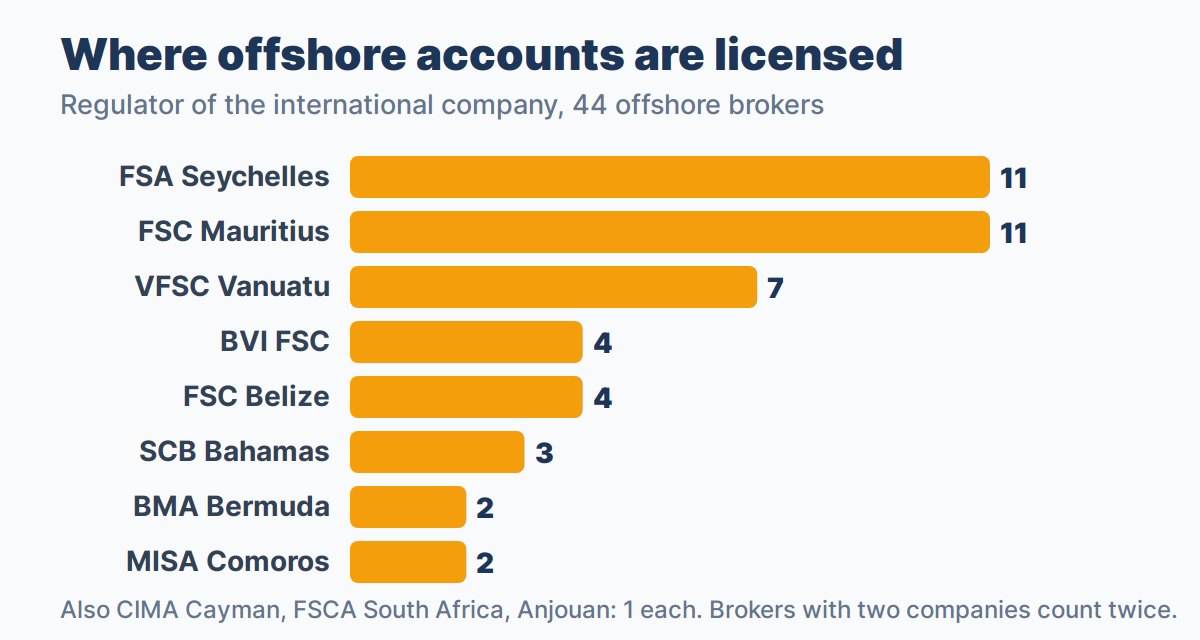
Among the 44 offshore forex brokers, the Seychelles FSA and the FSC Mauritius license the international company of 11 brokers each, followed by Vanuatu's VFSC (7), the BVI FSC and the FSC Belize (4 each). Some brokers use two companies, so they count twice. An offshore licence is still a licence: the company is registered, supervised and listed in a public register. What you usually do not get:
- No statutory compensation scheme. None of the offshore companies in our reviews names a scheme like the UK FSCS (up to GBP 85,000 at eToro UK) or Cyprus's Investor Compensation Fund (up to EUR 20,000 at eToro Europe). A few, such as RoboForex and MTrading, belong instead to the Financial Commission, a private dispute body with its own fund.
- Higher leverage and fewer limits. Leverage of 1:1000 or «unlimited» is offered only by offshore or unlicensed companies in our data.
- Weaker dispute routes. Complaints go to the offshore regulator or a private dispute body rather than a national ombudsman such as the UK Financial Ombudsman Service.
Unregulated forex brokers: 9 that name no regulator
Nine brokers in our reviews sign international clients with a company that is only registered as a business and names no financial regulator. Five more (Infinox, Opofinance, PU Prime, Valetax and STARTRADER) run a licensed offshore company next to an unlicensed one, so check which name is on your client agreement. Several of these are large brands with tier-1 licences elsewhere, which is exactly why the group name alone tells you little.
| Broker | Company that holds your account | Registered in | Licences elsewhere in the group | Licence & safety |
|---|---|---|---|---|
| HFM | HF Markets (SV) Ltd | St. Vincent and the Grenadines | FCA, CySEC, FSCA | 4/10 |
| ACY Securities | ACY Capital LLC | St. Vincent and the Grenadines | ASIC (Australians only) | 4/10 |
| LiteFinance | LiteFinance Global LLC | St. Vincent and the Grenadines | CySEC | 4/10 |
| Markets.com | Markets International Ltd | St. Vincent and the Grenadines | CySEC, FSCA | 4/10 |
| FXOpen | FXOpen Markets Ltd | Nevis | CySEC, FCA | 3/10 |
| Weltrade | Weltrade Ltd | Saint Lucia | FSCA introducer (South Africa only) | 3/10 |
| NordFX | NordFX LTD | Saint Lucia | FSC Mauritius (sister company) | 3/10 |
| Plexytrade | Plexy Trade Ltd | Saint Lucia | none named | 3/10 |
| MTrading | ServiceComsvg LLC | St. Vincent and the Grenadines | none named | 3/10 |
Unregulated does not have to mean a scam: HFM and Weltrade have run since 2010 and 2006 (as SystemForex), and both reset negative balances to zero. But no regulator checks their capital or how they handle your money, so you rely on the company's own word.
How to check a broker's licence in three steps
- Find the contracting company. Scroll to the footer of the website you would sign up on, or open the client agreement, and note the exact company name and licence number.
- Search that company in the regulator's register, not the broker's own page: for example the FCA register, ASIC Connect, the CySEC entities list, the US NFA BASIC search or the FSA Seychelles register. The website address in the register should match the one you are using; clone sites copy real licence numbers.
- Read what the licence covers: client money rules, negative balance protection and any compensation scheme. Each of our broker reviews lists every group company with its regulator and number.
Which regulator applies where you live
Forex regulators mostly protect their own residents. If you live in a country with a strong local regulator, use a broker licensed there: see FCA forex brokers in our best forex brokers in the UK guide, ASIC forex brokers in best forex brokers in Australia, NFA registered forex brokers in best forex brokers in the US and FSCA regulated brokers in best forex brokers in South Africa. EU residents get the CySEC forex brokers or other EU companies of the same groups. The full list is under best brokers by country.
Our picks
- Interactive Brokers: the strongest licence for an international account in our data (US SEC and CFTC, SIPC member) with no minimum deposit; note there is no negative balance protection on the main account.
- Saxo: a Danish bank under EU rules that also offers negative balance protection to retail clients and starts at EUR 0.
- Dukascopy: a Swiss bank (FINMA) from USD 100, if you accept that you are liable for a negative balance.
- eToro: the easiest regulated CFD broker to start with (USD 50–200), but check that your account is with an FCA, CySEC, ASIC or MAS company and not eToro (Seychelles).
- Pepperstone and IG: the best-scored offshore accounts (7/10 for safety), backed by groups with FCA and ASIC licences and negative balance protection for retail clients.
Cautions
- Licensed forex brokers can lose or change licences. We date every check; open the regulator's register before you deposit.
- A regulated brokers list on any site, including this one, is a starting point, not a guarantee. Regulation reduces some risks but does not protect you from trading losses.
- Be wary of anyone who contacts you as a «licensed account manager» and asks you to deposit through a personal Telegram or WhatsApp chat; check the firm and the website in the regulator's register first.
- Before your first trade, size your position with the lot size calculator and read what a margin call is.
FAQ
What is a regulated forex broker?
A broker whose company holds a licence from a financial regulator and must follow its rules on client money, capital and conduct. What matters is the licence of the company that holds your account, which is often different from the group's best-known licence.
Which forex brokers are regulated by a tier-1 regulator for international clients?
In our reviews, checked November 2026: Interactive Brokers (US SEC/CFTC), Saxo (Danish FSA), Dukascopy and Swissquote (FINMA), EXANTE (CySEC) and eToro (FCA, CySEC, ASIC or MAS, depending on your country).
Is an offshore forex broker safe?
An offshore licence means the company is registered and supervised, but usually without a statutory compensation scheme and with looser leverage limits. Check our licence & safety score and whether the broker offers negative balance protection.
How do I know which company holds my account?
Look at the client agreement and the legal footer of the website you sign up on. The company name and licence number there are the ones to check in the regulator's register.
Are unregulated forex brokers illegal?
Not always: some are registered companies in places that do not license forex dealers. But no regulator supervises them, so you depend on the company's own policies if something goes wrong.
Risk warning: CFDs and leveraged forex are complex instruments with a high risk of losing money rapidly due to leverage. Regulation does not protect you against trading losses. This article is information, not investment advice.